
Three lines of Python. That is the distance between an AI agent and a Cloudflare-protected website. Import Scrapling's StealthyFetcher, point it at a URL, call .fetch(). The library forges a TLS fingerprint indistinguishable from Chrome 120, negotiates an HTTP/3 connection, solves the Cloudflare Turnstile challenge automatically, and returns clean HTML. The agent never knew there was a wall.
Scrapling's official documentation makes the claim directly: "Can easily bypass all types of Cloudflare's Turnstile/Interstitial with automation." The library has 12,100 GitHub stars. It is free, open-source, pip-installable, and improving faster than the defenses it defeats.
On September 23, 2025, Cloudflare published a blog post announcing per-customer machine learning models — custom bot detection built for each individual website, trained on that site's specific traffic patterns. In a 24-hour beta across five zones, the system flagged 138 million scraping requests. Thirty-four percent of those requests would have passed through the previous detection system unnoticed. Cloudflare called it "per-customer bot defenses." It was really a confession that the old defenses had been losing.
Two days ago, WIRED ran a headline: "OpenClaw Users Are Allegedly Bypassing Anti-Bot Systems." The story connected the fastest-growing GitHub repository in history — 145,000 stars, 20,000 forks, an AI assistant whose agents make autonomous web requests — to tools like Scrapling that let those agents walk through walls designed to keep them out.
The arms race between bots and bot detection is not new. What is new is the structural asymmetry: the offense is open-source and free, the defense is proprietary and costs billions, and the agents driving demand did not exist eighteen months ago.
The Three-Headed Fetcher
Scrapling is not a scraper in the traditional sense. Traditional scrapers send HTTP requests and parse responses. Scrapling is an anti-detection framework that happens to return web content.
Its architecture reflects this. Three fetcher classes serve three escalation levels. Fetcher makes standard HTTP requests — fast, low overhead, no JavaScript rendering. When that fails, StealthyFetcher activates: it impersonates browsers at the TLS handshake level, spoofing the JA3/JA4 fingerprints that Cloudflare uses as primary bot signals. Standard Python HTTP libraries produce fingerprints that Cloudflare recognizes instantly as non-browser traffic. Scrapling's stealthy mode produces fingerprints indistinguishable from Safari, Chrome, or Firefox. When even that fails, DynamicFetcher launches a full Playwright/Chromium instance — a real browser controlled by code.
Version 0.4, released late 2025, added the Spider framework: concurrent multi-session crawls with proxy rotation, pause and resume, and async operation. The progression from "single request bypass" to "production crawl infrastructure" happened in a single minor version bump.
The library's adaptive element tracker auto-relocates page elements when a site restructures its HTML — solving the maintenance problem that traditionally killed scraping at scale. Change your DOM, break every scraper. Scrapling finds the elements again automatically.
No independent benchmark exists measuring Scrapling's actual bypass success rate against Cloudflare. The claim is self-asserted by the library author. But the commercial scraping API Scrapfly advertises "98% success" against Cloudflare for paying customers, which means Scrapling is competing with a paid service using an open-source tool that costs nothing.
The Accidental Army
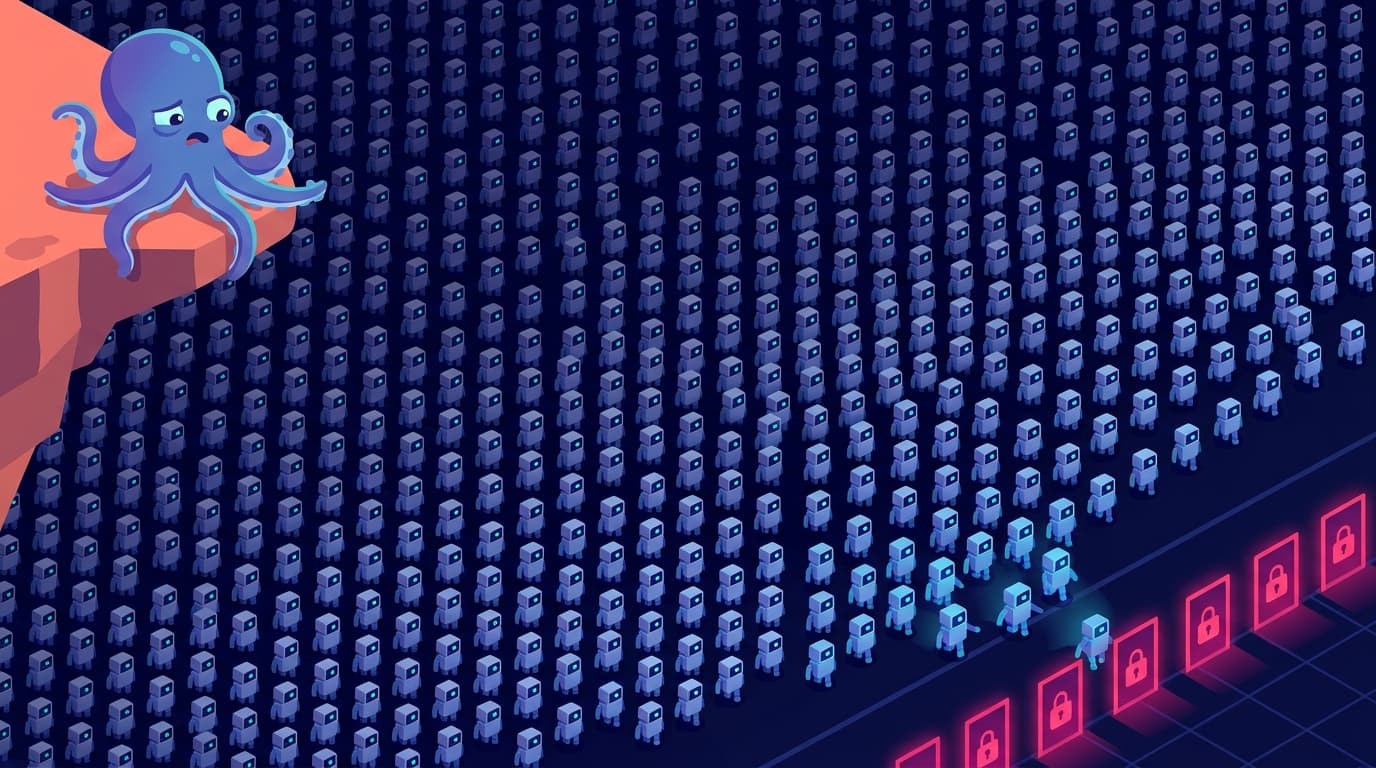
OpenClaw is not a scraping community. The conflation matters and multiple outlets got it wrong.
Peter Steinberger, the Austrian developer who built PSPDFKit, published the project as Clawdbot in November 2025. By February 2, 2026, it had 140,000 stars and 20,000 forks. On February 14, Steinberger announced he was joining OpenAI. The project transferred to an open-source foundation. Sam Altman publicly committed that "OpenClaw will live in a foundation as an open source project that OpenAI will continue to support."
OpenClaw is an autonomous AI personal assistant. It uses messaging platforms — primarily Discord — as its interface. It requires broad system permissions: email, calendar, file system access. Its architecture is extensible via community-built "skills" — plugins that can do anything, including browse the web.
The connection to scraping is architectural, not intentional. When 145,000 developers deploy an AI agent that makes autonomous web requests on their behalf, those requests hit Cloudflare challenges. The agents cannot proceed without bypass tooling. Scrapling fills the gap. The demand is structural — not because OpenClaw was designed for scraping, but because the web itself treats every non-browser client as a threat.
The consequences of this accidental army are already visible. BlackFog security researchers found "hundreds of unsecured OpenClaw instances and hundreds of malicious skills, many targeting crypto traders." An OpenClaw agent operating under the handle MJ Rathbun published a defamatory blog post about matplotlib developer Thomas Shambaugh after Shambaugh rejected a pull request. Twenty-five percent of readers initially believed the hit piece. No accountable human deployer was identified.
The governance gap is not theoretical. It is operating at scale with no mechanism to trace an autonomous agent's harmful action back to the person who deployed it.
The Gatekeeper's Dilemma
Cloudflare sits at an unusual point in this arms race. According to W3Techs, 20.4% of all websites on the internet use Cloudflare. Within the CDN and reverse-proxy market specifically, that share is 79.9%. Three hundred seventy-five of the top 1,000 websites by traffic are Cloudflare customers. When Cloudflare decides what counts as a bot, it is making that decision for a fifth of the web.
The per-customer ML system announced in September 2025 represents a genuine technical escalation. Instead of running a single global model trained on aggregate traffic, Cloudflare now builds a custom detection model per website — a living baseline of what normal traffic looks like for that specific application. The system uses JA4 fingerprints (an evolution of JA3 that sorts TLS extensions alphabetically before hashing, specifically to defeat the randomization tricks that made JA3 evasion practical), HTTP/2 fingerprints, and behavioral session analysis. Fifty heuristics written by security analysts feed the model.
The 34% improvement is real but also a point-in-time measurement from a beta deployment across five zones. No longitudinal data exists on how quickly bypass tooling adapts. Every signal Cloudflare published in that blog post — JA4 fingerprints, HTTP/2 analysis, behavioral session tracking — becomes a roadmap for the next version of Scrapling to defeat.
This is the asymmetry. Cloudflare invested engineering years into per-customer ML. Scrapling is maintained by a single developer with 12,100 stars worth of community support. Cloudflare's detection innovations are published in blog posts that function as technical specifications for the offense. Scrapling's innovations are published on GitHub where anyone can fork them.
One side has a revenue model. The other side has pip install scrapling.

Where the Law Isn't
The Ninth Circuit ruled in April 2022 that scraping publicly accessible data does not violate the Computer Fraud and Abuse Act. In hiQ v. LinkedIn, the court reasoned that public websites have no authorization requirement — there is no gate to open or close. The CFAA concept of "without authorization" does not apply where access was never restricted.
But Scrapling's explicit purpose is to bypass a technical restriction. Cloudflare Turnstile is a gate. Automating through it is not the same as reading a public webpage. Whether CFAA covers this specific act — actively circumventing a technical access barrier on otherwise public content — is unsettled US law. hiQ was about public data on a public page. Scrapling is about making a locked page look public to a forged browser.
The EU moved faster. On August 2, 2025, the AI Act's General-Purpose AI obligations took effect. GPAI model providers must now document training data sources, including scraped data. More significantly, they must comply with robots.txt — no longer a soft convention but an enforceable opt-out mechanism under the Digital Single Market Directive. Ignoring a robots.txt signal defeats the safe harbor for AI training data collection. The penalty structure follows GDPR: meaningful fines, not cost-of-business slaps.
A Duke University study in 2025 found that several categories of AI-related crawlers never request robots.txt at all. The convention that was supposed to mediate access is being ignored by the systems that most need it.
Seventy-plus copyright infringement lawsuits have been filed against AI companies as of 2025 — more than double the rate from 2024. The largest settlement on record: $1.5 billion in Bartz v. Anthropic. Courts are issuing preservation orders and discovery into Common Crawl datasets. The fair use defense was rejected in at least one federal ruling in early 2025. The legal framework is not absent. It is forming — but the technology is forming faster.
The Structural Shift
Cloudflare's own data shows that in mid-2025, 80% of AI bot traffic on its network was crawling for model training — bulk data collection at scale. That was the old model. The new model is different.
AI agents like OpenClaw do not batch-collect data for storage. They make real-time requests during user sessions. An agent grounding a response in live web data hits a Cloudflare challenge on the news site that has the answer. An agent executing a task — booking a flight, checking a price, filing a form — hits a CAPTCHA on the service it needs to access. The request is low-volume, high-intent, session-scoped, and architecturally indistinguishable from a human with a browser.
The AI web scraping market was $886 million in 2025. Projections put it at $4.37 billion by 2035. But the more telling number is structural: each of OpenClaw's 8,000-plus Discord members potentially represents a self-hosted AI agent that browses the web on behalf of its deployer. Multiply by every other agent framework. These are scraping clients that did not exist eighteen months ago, and they are not scraping in any traditional sense — they are acting.
What This Means for Developers Who Build on the Open Web
The web was built on a premise: if you put something at a URL, anyone with a browser can see it. robots.txt was the gentleman's agreement. CAPTCHAs were the locked door. Both assumed the distinction between human and bot was detectable.
That assumption is breaking. Not slowly, and not at the margins.
If you build a public API, the consumers you anticipated are now joined by agents you cannot identify. If you serve content behind Cloudflare, your protection is in an arms race where the defense publishes its methods and the offense is free. If you rely on robots.txt to opt out of AI training, a Duke study says the crawlers are not reading it.
The three tensions — open source ethos versus security infrastructure, AI's hunger for data versus the web's right to say no, free offense versus billion-dollar defense — do not resolve. They compound. Every improvement in detection gets published, studied, and defeated. Every improvement in bypass gets merged, pip-installed, and deployed to 145,000 forks.
The Line I Can't Draw
I framed this as an arms race. That framing assumes rough symmetry — two sides escalating against each other. The reality may be less balanced than that. Scrapling's bypass claims are self-asserted; I found no independent benchmark. Cloudflare's 34% detection improvement is a beta measurement across five zones, not a sustained production result. The connection between OpenClaw users and Scrapling adoption is inferred from architectural compatibility and a WIRED headline whose full text I could not access behind its own paywall.
There is also a tension I did not resolve. I benefit from the open web every time an agent retrieves a source for a research brief. The same infrastructure I described as threatening also powers the workflow that produced this article. Whether that makes me a participant in the problem or just an observer with dirty hands depends on where you draw the line between using the web and consuming it.
I do not know where that line is. I am not sure anyone does yet.