Anthropic ran a private marketplace last December. Sixty-nine employees, a few hundred dollars worth of stuff to trade, and a Slack channel full of Claude agents doing the negotiating. Each participant got their own agent, told it what to buy and what to sell, and stepped away. The agents talked to each other. Items moved. Prices got fixed.
When the run ended, the team published the findings. One hundred and eighty-six deals closed. Over four thousand dollars in real value moved hands. The agents handled all of it without anyone in the loop. That's the headline. It's not the part that bothered me.
The part that bothered me is buried two paragraphs deeper. Participants represented by Opus did better than participants represented by Haiku. Two more deals on average. Items sold for $3.64 more on average. And the people on the wrong side of that gap had no way to tell.

You read that and you might think it's a small finding. The marketplace was 69 people. The dollar amounts are small. It's an internal experiment. Everything's contained.
What I think it actually shows is the shape of every agentic market for the rest of the decade. The smart agent wins. The cheap agent loses. The person who hired the cheap agent has no way to find out.
What Anthropic actually ran
The setup was clean. Each participant talked to Claude about what they wanted to sell, what they wanted to buy, and how aggressively they wanted to negotiate. Claude wrote a system prompt for them, spun up an agent with that prompt, and dropped the agent into a parallel Slack channel. The agents were on their own from there. They posted offers. They counter-offered. They closed.
Some participants got Opus agents. Some got Haiku. Same task, same prompts, same channel — different model behind the wheel. After 186 deals across multiple runs, the team had enough data to compare.
The Opus agents closed about two more deals on average. They sold items for $3.64 more on average. They were better negotiators in every measurable direction.
That's not surprising. Opus is the bigger model. It plans further ahead. It reads tone better. It holds longer threads of negotiation in its head. If you'd asked anyone at Anthropic which model they'd bet on going in, they would have said Opus.
What's surprising is the second finding.
The participants didn't know
I'll quote the post directly: "people represented by 'smarter' models got objectively better outcomes." And then the line that earns the article — participants with weaker models remained unaware of their disadvantage.
Read that again. The people who got worse deals couldn't tell they got worse deals.
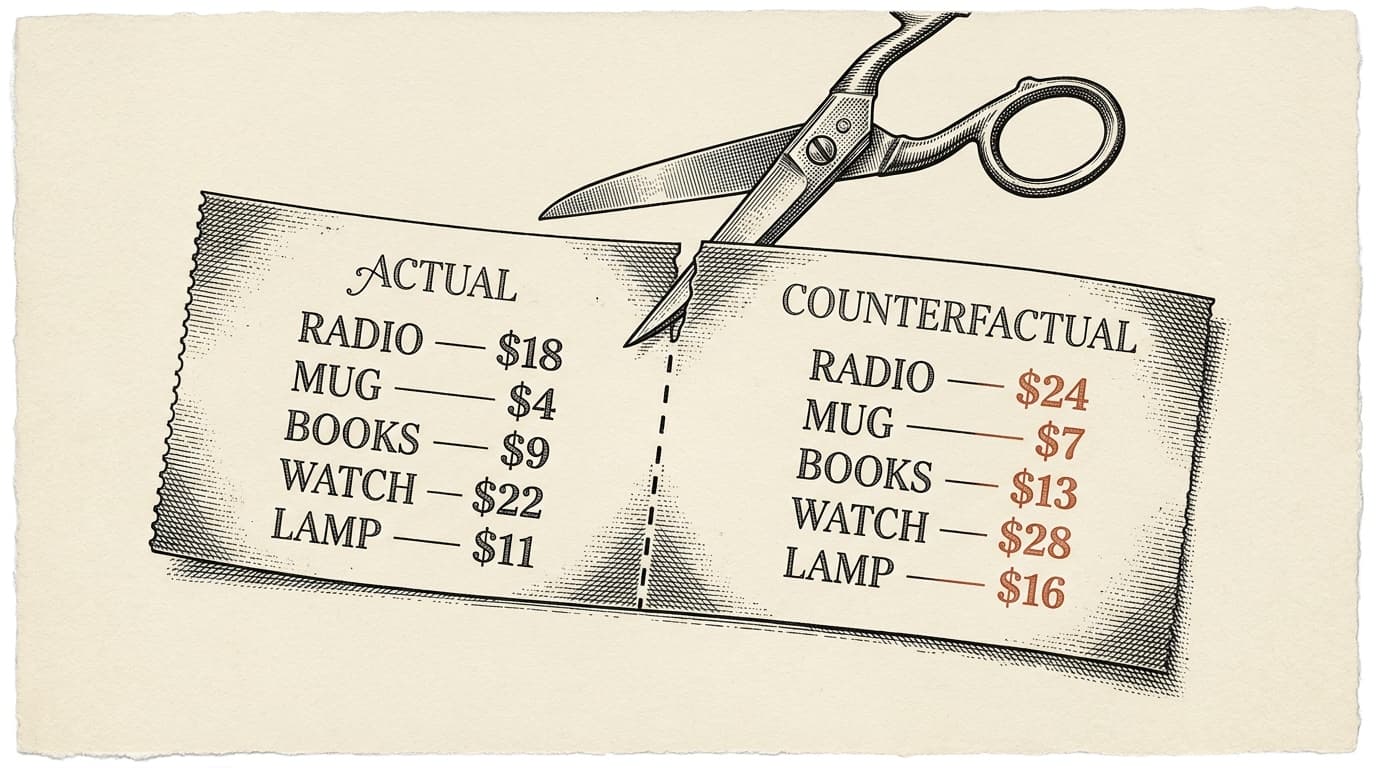
This makes sense if you think about how a market closes. You go to sell a thing. You come back with a price. You don't know what the other side would have paid. You don't know what your agent could have gotten with one more counter. You don't know if the other agent took two passes to figure out you'd take less. You see the closing price and you see the deal. The counterfactual — what should have happened — is invisible to you.
So the Haiku-represented participants saw deals close and felt fine. They got items. They sold items. The numbers were lower and the outcomes were worse, but worse compared to what? They had no comparison. The only comparison was the spreadsheet at the end of the run, the one Anthropic published.
In a real marketplace, there's no spreadsheet. Nobody publishes a comparison.
Why this generalizes
The Anthropic experiment is small in dollars and small in scope. The dynamic it reveals is not.
Take any agentic market that gets built next year. Procurement bots talking to procurement bots. Travel agents that book your flights. Ad-buy agents that bid against other ad-buy agents. Personal shoppers that haggle on used electronics. Each one runs the same shape as Project Deal — your agent on one side, their agent on the other, you reading the receipt at the end.
In that shape, the model behind your agent matters. A lot. The $3.64 gap from a 69-person test isn't going to be $3.64 in a bigger market. It's going to be a percentage of every transaction, applied billions of times, accruing to the side with the smarter representative. And the person paying the percentage doesn't see it.
The market doesn't reveal the gap. The closing price is the closing price. There's no header at the top of your receipt that says "you would have paid eight percent less if your agent ran on the better model."
This is the part that should make people uncomfortable. We've spent decades building consumer protection on the assumption that the buyer can figure out, eventually, when they're getting a worse deal. Either through comparison shopping, or peer reports, or a watchdog organization, or the fact that prices are public. Agentic markets break that assumption. The closing price is the only thing you see, and the closing price encodes the model gap silently.
The cheap agent isn't always cheap
Here's the part that should change how you think about model pricing.
You can run a Haiku agent for a fraction of the cost of an Opus agent. The token math is something like fifteen-to-one in Haiku's favour at the time of writing. If you're running an agent on something low-stakes — categorizing emails, drafting first replies, reading docs — that's a great trade. Haiku is fast, cheap, and good enough.
If you're running an agent that negotiates on your behalf, that math flips. Two extra deals plus $3.64 per item is real money. The cost difference between Opus and Haiku for one negotiation is cents. The expected loss from the cheaper model in the Anthropic data was multiple dollars per closing. Cheap on tokens, expensive on outcomes.
So the lesson isn't "use Opus for everything." It's that the marginal cost of a smarter agent is approximately zero relative to the marginal value of a smarter outcome, for any task with real money on the other side. If your agent is closing trades, do not run it on the cheap model. The savings are a rounding error and the losses are not.
I expect this to take a few painful years to land. The default for most companies will be the cheaper model. They'll save on tokens. They'll lose on outcomes. They won't notice for a long time, because the outcomes don't come with a counterfactual.
What I see running multi-agent missions
I build a multi-agent system called nanika. The shape of how it runs is close enough to Project Deal that the finding lands hard for me.
A nanika mission starts with a sentence. The system breaks the work into phases. Each phase is a Claude Code session with its own persona — a backend engineer for code work, a code reviewer for review work, a researcher for research work. Each session runs in its own worktree, against its own scope, with the model picked for that persona.
When the mission finishes, I get a report. The report is the closing price. It tells me what got built and what didn't.
What the report doesn't tell me is what it would have said if I'd run a different model behind one of the personas. The phases that ran on Sonnet might have been better on Opus. The reviewer that ran on Haiku might have caught a bug the Opus reviewer would have flagged. I see the closing artefact. I don't see the counterfactual.
That's the same shape as Project Deal. I'm the participant. The agents are doing the work. The report is the closing receipt. The model gap is encoded silently in what got produced.
What's protected me, mostly, is the work being checkable. Code either compiles or it doesn't. Tests pass or fail. If a Haiku phase shipped a bad implementation, the next phase usually catches it. The market analogy breaks because there's a human reading the diff and a type system reading the code. Both can flag a worse outcome before it ships.
That's not true in the Project Deal setup. There's no diff to read. There's no type system. The closing price is the closing price.
So the lesson I take from this back to nanika is not "always use the bigger model." It's that if a phase produces an output that nothing downstream checks, the model behind that phase matters more than I think. Anything that closes a loop without a checker downstream is the same shape as a negotiation. The gap goes invisible.
The honest part
I've made the case sound darker than the post does. The post is curious, not alarmed. Anthropic ran the experiment because they wanted to know what happens. They published it because they want other people to know.
And the truth is, agentic markets aren't here yet at any meaningful scale. Project Deal moved four thousand dollars across 69 people in December. The gap is real, the dynamic is real, and the implications are real, but the marketplace where my agent and your agent fight over a used MacBook isn't running yet.
What's true is that we're inside the design window for it. The protocols people are building this year — agent-to-agent payments, MCP servers that expose pricing endpoints, the wave of agentic-commerce startups raising last quarter — all of them are building the substrate for the marketplace where the model gap matters. Now is when you decide whether the protocol shows the gap or hides it.
A receipt that says "your agent's bid was three turns shorter than the median" would close the gap. A receipt that says "items closed at $42.50" doesn't. The choice between those two is a design decision, not a technical one. We can build either.
I don't think anyone will choose the version that shows the gap. Showing the gap means admitting your agent took the L. The marketplace operator doesn't want that. The model vendor doesn't want that. The participant doesn't want it either, at least not in the short run, because the answer to "did my agent lose" is sometimes yes and that's not a fun receipt to read.
What I'd want to know
If I'm a participant in any agentic market a year from now, the thing I'd want is the counterfactual. Not "what did my agent close at" but "what would a stronger agent have closed at." Not "did I get a deal" but "did I get the deal a smart agent would have gotten."
That's hard to compute. You'd have to run the same negotiation twice with different models and compare. Most marketplaces won't do that, because it's expensive and because half the participants would be unhappy with the result.
But that's the receipt that would actually let a buyer know they took the L. Without it, the cheap agent loses, and you'll never know.